
Money Train 2 (Relax Gaming) “Feature Drop” and bonus rounds: how to assess risk when the main payouts live in the bonus
Money Train 2 is a useful case study for anyone trying to understand modern high-volatility slots, because the “interesting” money is not evenly distributed across the game. Most sessions are shaped by whether you reach the Money Cart Bonus Round and what happens once you’re inside it, which is why players talk about bonus hunting and feature buys more than line wins. The aim of this guide is to treat the Feature Drop (bonus buy) like a financial decision: you are paying for access to variance, not buying a “better chance” of winning.
What “risk” really means in Money Train 2 (and why base-game results can mislead)
In a bonus-led slot, the base game can be a poor indicator of the game’s real swing. You can have a session that looks “quiet” for long stretches and still be perfectly consistent with the maths, because a large part of the expected return is concentrated in comparatively rare bonus events. This is exactly the pattern Money Train 2 is designed for: you are effectively waiting for the Money Cart Bonus to do the heavy lifting, while the base game mostly provides the entry route.
Start by separating three different ideas that often get mixed up. RTP is the long-run theoretical return (and it can vary by version), volatility is the size and frequency of swings, and session outcome is what happens to your balance in a limited time window. A slot can have a decent theoretical return and still be brutal in short sessions, especially when a small number of outcomes carry a huge share of the upside.
That’s why a sensible risk check in 2026 begins with a simple question: “How many bonus events can I afford to see?” If your stake is sized so that even a normal run of misses forces you to stop, then the session becomes a coin flip on timing rather than a planned spend. With an extreme-volatility game, you plan for misses first and treat hits as upside, not as something you can schedule.
A 2026 checklist: RTP profile, volatility label, and feature availability
Before you assess any strategy, confirm what you are actually playing. Money Train 2 is widely listed with an RTP that can be set by the operator, and some sources note different profiles (for example, versions around 96.4% and lower configurations in some markets). If the game menu or the casino info panel does not show the RTP, that is already a warning sign for anyone trying to be disciplined about expected value.
Next, treat “extreme volatility” as a practical constraint, not a marketing label. Extreme volatility means two things for the player: (1) your bankroll needs to absorb long stretches where nothing notable happens, and (2) your biggest wins will cluster in rare, spiky events rather than being spread across steady line hits. Money Train 2 also advertises a very high maximum win (commonly cited up to 50,000x), which is another signal that the distribution is heavy-tailed and the median outcome will be far below the headline.
Finally, check whether you can even use the Feature Drop in your jurisdiction. The buy feature is not universally available; for example, UK-facing casinos generally do not offer bonus-buy mechanics after regulatory action, so players see the standard trigger route instead. That matters for risk planning because removing Feature Drop forces longer sessions and changes how quickly you can reach the high-variance part of the game.
How the Money Cart Bonus concentrates value (and why Feature Drop changes your spending pattern)
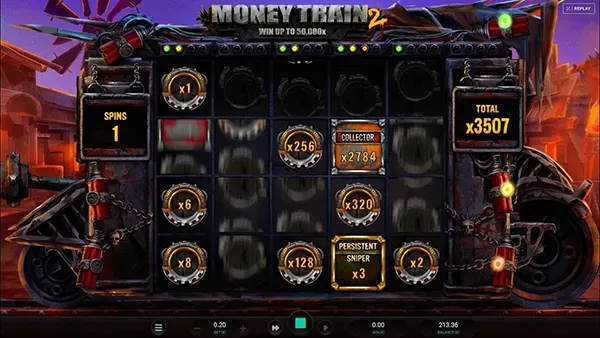
The Money Cart Bonus Round is the centre of gravity in this title. Relax Gaming describes a scatter-triggered bonus where players start with a limited number of spins and can extend the round by landing additional symbols, while character symbols interact with values in ways that can escalate outcomes sharply. In practice, the bonus behaves like a separate mini-game with its own rules and its own “luck curve”, and that’s where players either see small refunds or the kind of hit they remember.
Feature Drop changes the psychology of the spend, even if the maths stayed constant. Paying to enter the bonus removes the waiting time and compresses outcomes into fewer, more expensive decisions. That can be useful if you’re deliberately budgeting for a set number of bonus entries, but it can be harmful if it encourages impulsive “one more try” behaviour, because each purchase is effectively a high-variance bet.
Another important point is that “main payouts sit in the bonus” does not mean the bonus is “due” after a dry spell. The game does not owe you a bonus, and it does not owe you a strong bonus just because you paid for entry. If you treat Feature Drop as a shortcut to profit rather than a shortcut to variance, you will almost always over-spend relative to your original plan.
Reading the bonus like a risk analyst: symbols, persistence, and escalation
To evaluate risk inside the bonus, focus on how outcomes can escalate rather than on individual symbol names. Relax’s own description highlights character types and persistence behaviour (some effects can persist across spins, others do not), plus a dynamic where the round can keep going when new symbols land. In risk terms, that is a recipe for “path dependence”: two bonuses with the same entry cost can produce wildly different results depending on early symbol interactions.
The practical implication is that your average bonus will often look unimpressive, because the bonus is built to allow a small number of rounds to do most of the rewarding. That is typical of high-volatility design: many modest bonuses, a few strong bonuses, and a very small number of exceptional outcomes. When you buy the bonus, you are purchasing repeated exposure to that distribution, not buying a “better” distribution.
A useful discipline trick is to pre-define what you consider a “good outcome” for your budget. For example, if you buy into the bonus multiple times, decide in advance what result counts as a stop signal (a certain profit, a certain recovery of spend, or a hard cap on entries). Without a rule, you’ll judge outcomes emotionally, which is exactly how high-variance games turn a planned spend into a drifting spend.
Practical bankroll rules for Feature Drop sessions (with realistic expectations)
If you choose to use Feature Drop where it’s offered, treat the session as a fixed-cost experiment. Decide the total amount you’re willing to spend, convert that into a number of bonus entries (not spins), and stop when you hit the number. This is the cleanest way to keep the buy feature from turning into an open-ended chase, because it frames the session as a limited sample of high-volatility events.
Stake sizing matters more here than in lower-volatility slots. With extreme volatility, doubling the stake does not simply “speed up” the session; it can shorten your runway so much that you never experience enough bonus events to see the game’s intended distribution. Many players accidentally create this trap by staking at a level that feels reasonable per spin, but is not reasonable per bonus entry once they start buying features.
Also be clear about what a responsible session looks like. A responsible session is not “I stopped when I was up”; it is “I stopped when I reached my pre-set limit or pre-set target.” Those are different behaviours. With bonus-led games, emotional stopping rules tend to kick in at the worst moments: after a string of small bonuses or near-misses, when the temptation to “correct” the session is strongest.
Risk controls that actually work: caps, spacing, and reality checks
Use hard caps rather than vague intentions. A hard cap can be a maximum number of Feature Drops, a maximum loss amount, or a fixed time limit, but it must be defined before you start. Once you enter the cycle of buying “just one more”, the game is already doing what it was designed to do: keep you paying for the chance of an outlier bonus.
Spacing is another under-used tool. If you buy features, build in breaks between entries and review your spend like you would with any other discretionary purchase. This does two things: it reduces impulsive repeats, and it helps you notice whether your stake size is forcing you into uncomfortable decisions. If you feel the need to “win back” the last buy, that is a signal to stop, not a signal to continue.
Finally, keep your expectations grounded in what the game advertises and implies. A high max win is not a promise; it’s a sign that the tail is long and the typical outcome is far smaller. Treat the bonus as entertainment with a measurable cost, not as a plan to generate income. If you want a lower-swing experience, the most rational decision is not a new strategy inside Money Train 2—it’s choosing a lower-volatility game in the first place.
Popular slots
-
Genie Jackpots Combo Frenzy (Blueprint Gam...
The Genie Jackpots Combo Frenzy mechanic developed …

-
The Last Sundown by Nolimit City: xNudge, ...
The Last Sundown by Nolimit City is …

-
Cash Crew Slot Review: Heist Mechanics and...
Cash Crew is a modern video slot …